
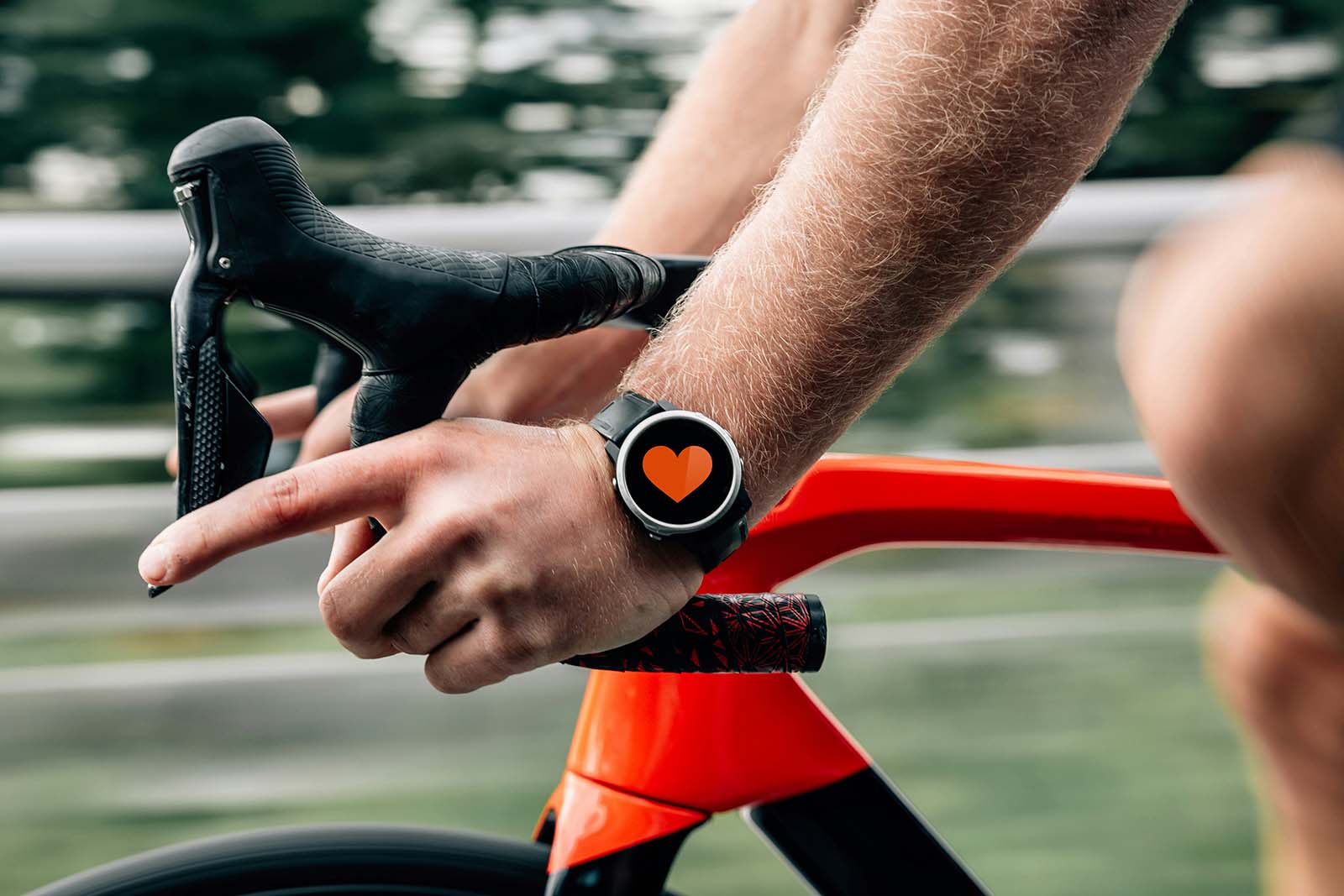
If you spend any amount of time around cyclists, you will hear people talk about numbers. Power. Speed. Cadence. Elevation. Many riders focus heavily on external performance metrics. But one of the simplest and most useful tools available to any cyclist is often misunderstood or underused. That tool is the heart rate monitor.
At its core, a heart rate monitor does something very straightforward. It measures how fast your heart is beating. That may sound basic, but it provides direct insight into how hard your body is actually working. Not how fast you are travelling. Not how many watts you are producing. But how much internal stress your effort is placing on your system.
When you are cycling, especially over longer distances or when climbing in Mallorca, understanding internal effort can be more valuable than watching your speed. Wind, gradient, road surface, fatigue, and temperature all influence how fast you move. Heart rate reflects what is happening inside your body regardless of those external factors.
There are several types of heart rate monitors available. Wrist based optical sensors are common and convenient. However, chest straps tend to provide more consistent readings, especially during higher intensity efforts or long steady climbs. Most modern cycling computers connect easily to heart rate monitors, making them simple to integrate into your riding.
Some cyclists believe heart rate is unreliable because it can be influenced by heat, hydration, sleep quality, or stress levels. That is partly true. But rather than making it inaccurate, those variations provide valuable information. If your heart rate is unusually high for a familiar effort, it may be a sign that you are fatigued, dehydrated, or under recovered. If it is slightly lower at the same pace after consistent training, that often signals positive adaptation.
Imagine riding on a warm day in Mallorca. As temperatures rise, your body works harder to regulate heat. Your heart rate may gradually increase even if your power remains steady. This phenomenon, often referred to as cardiac drift, is not a flaw in the data. It is your body responding to environmental stress. Observing that rise helps you understand your limits and manage effort more intelligently.
Another important comparison is between heart rate and power. Power measures external output. Heart rate measures internal load. They are not measuring the same thing. You might produce identical power on two different days, yet your heart rate could vary depending on recovery, nutrition, or overall fatigue. That is precisely why heart rate remains such a valuable tool, even for cyclists who train with power meters.
Understanding what heart rate represents is one thing. Knowing when to use it effectively is where it becomes powerful.
Power responds immediately to effort. If you push harder, the number rises straight away. Heart rate behaves differently. It takes time to respond. It reflects what your cardiovascular system is experiencing rather than what your legs are producing at that exact second.
That delayed response is sometimes seen as a disadvantage. In reality, it simply provides a different perspective.
Heart rate becomes especially useful during longer efforts. When climbing in Mallorca, you often face sustained gradients that can last twenty or thirty minutes or more. It is easy to start a climb too aggressively. The road tilts upward, adrenaline rises, and you push harder than you realise. Your power may spike immediately, but your heart rate will gradually climb in response.
By monitoring heart rate, you begin to understand pacing on a deeper level. If you see it rising beyond a sustainable range early in a climb, you can ease slightly before fatigue accumulates. Over a single ride, that awareness helps. Over six consecutive days of riding, it becomes essential.
At Velocamp Mallorca, our six day cycling camp covers approximately 518 kilometres and 8,331 meters of climbing. Managing that workload requires patience. You cannot treat every climb like a race. You need consistency. Heart rate monitoring becomes a tool that keeps effort controlled across the entire week.
There are also specific periods during the season when heart rate becomes particularly valuable. After a break from training, your power output may decline quickly. However, your cardiovascular system often maintains a more stable base capacity. During those early weeks back on the bike, heart rate provides a reliable reference point while power numbers rebuild.
Similarly, on endurance focused rides where the goal is simply to accumulate hours, heart rate helps prevent unintended intensity. Many riders intend to ride easy but drift into higher effort zones without realising. Monitoring heart rate ensures those sessions remain truly aerobic, which is crucial for long term development.
Training zones based on heart rate offer another practical approach. Lower intensity zones support recovery and aerobic development. Middle zones build sustained endurance. Higher zones place greater stress on the system and should be used carefully. Understanding which zone you are in helps you train with intention rather than guesswork.
It is also important to remember that heart rate does not replace other metrics. It complements them. Power tells you what you are doing externally. Heart rate tells you how your body is responding internally. When both align, you gain clarity. When they differ, you gain insight.
This becomes especially noticeable during a multi day cycling camp in Mallorca. On day one, heart rate may sit slightly higher due to excitement and freshness. By mid week, riders often find they can hold steady efforts with more stable heart rate responses. By day six, it is common to see similar outputs achieved with slightly lower heart rates. That small shift represents real adaptation happening in real time.
Over 518 kilometres and more than 8,331 meters of climbing, pacing mistakes add up. Starting too hard on early climbs can affect the entire week. Riding recovery sections slightly too hard can quietly drain energy. A heart rate monitor keeps effort in check without overcomplicating the experience.
Climbing in Mallorca provides the perfect environment to apply this awareness. The steady gradients of the Tramuntana mountains allow riders to settle into controlled intensities. Instead of chasing speed or comparing with others, you focus on maintaining sustainable internal effort.
At Velocamp Mallorca, we encourage guests to use heart rate monitoring as a guide. Not in a rigid or overly technical way, but as a tool for awareness. For any guest who does not already own a heart rate monitor, we provide one free of charge for the week.
This removes barriers. You do not need expensive equipment or advanced knowledge. You simply gain insight into your own body.
Combined with daily structured riding, proper recovery, nourishing meals prepared by our private chef, professional massage, stretching facilities, and time to relax by the pool, your body is placed in an ideal environment for adaptation. The heart rate monitor simply helps you manage and observe that process intelligently.
The goal is not to turn every ride into a laboratory session. The goal is to ride smarter so that you finish the week feeling stronger, not depleted.
Cycling in Mallorca offers exceptional terrain. Long steady climbs. Smooth open roads. Consistent gradients. When paired with intelligent pacing and internal awareness, the improvements can be significant.
If you are curious about how a structured six day cycling camp in Mallorca can improve your endurance, confidence, and understanding of your own effort, we would love to welcome you.
At Velocamp Mallorca, you will ride challenging routes, climb iconic mountains, recover properly each day, and learn to manage your effort in a way that stays with you long after the camp ends.
To learn more about our upcoming cycling camps in Mallorca and to secure your place, visit www.velocampmallorca.com.
Sometimes the simplest tool makes the biggest difference. And often the most meaningful improvements come not from riding harder, but from riding smarter.
85 pages of tips, including bike hire, best routes, our favourite coffee stops, cycle clothing shops, and plenty more!
supported by